
Palm sugar for bubble tea
A guide for bubble tea chains, tapioca pearl makers and syrup suppliers: how arenga palm sugar works as the dark syrup in brown sugar drinks, how to cook it for pearls and glass streaks, and how we supply it from Indonesia.
Last updated
2:1
Pearl syrup
Two parts palm sugar to one part water by weight, reduced until it coats a spoon.
The syrup is the drink
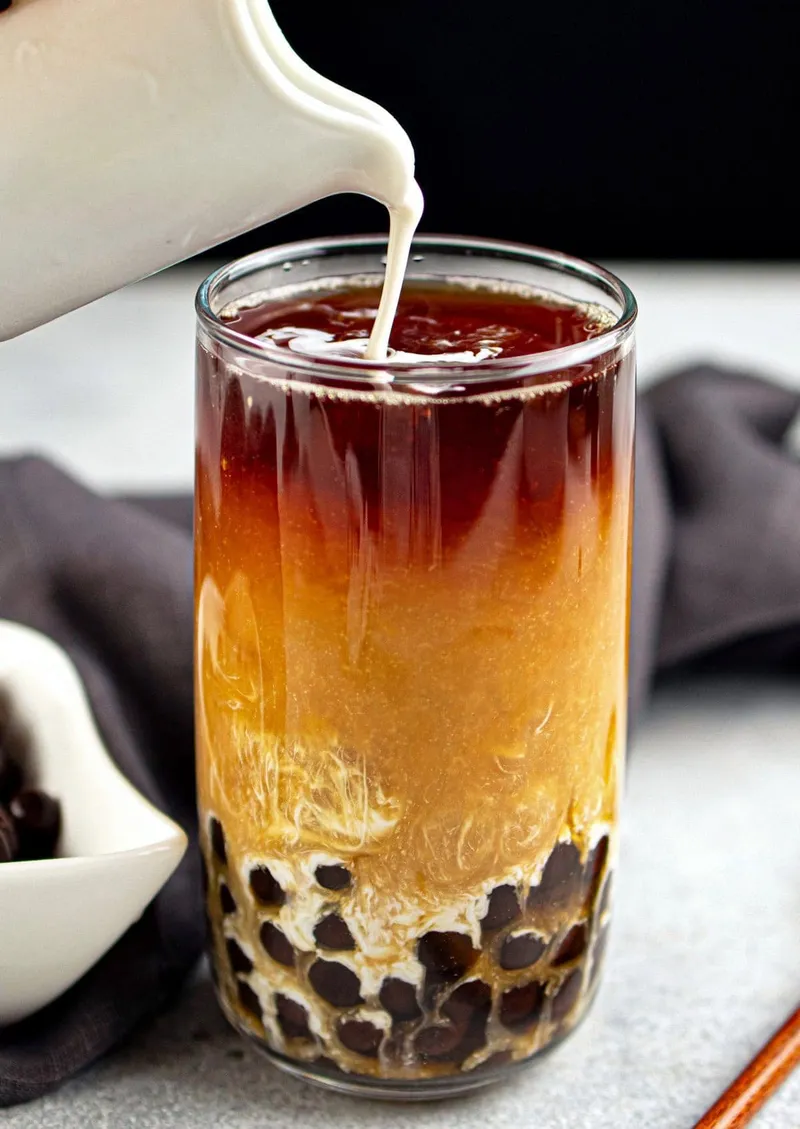
Brown sugar milk with tapioca pearls.
Bubble tea started in Taiwan, and its brown sugar version is now on menus far beyond it: warm tapioca pearls soaked in a dark syrup, the syrup smeared up the inside of the glass in streaks, then cold milk poured over. The syrup gives the drink its color, its look in the glass and most of its flavor.
Arenga palm sugar makes that syrup with a caramel and toffee taste and a slightly smoky finish. For a chain it means a different flavor story on the menu with the same method the staff already know.
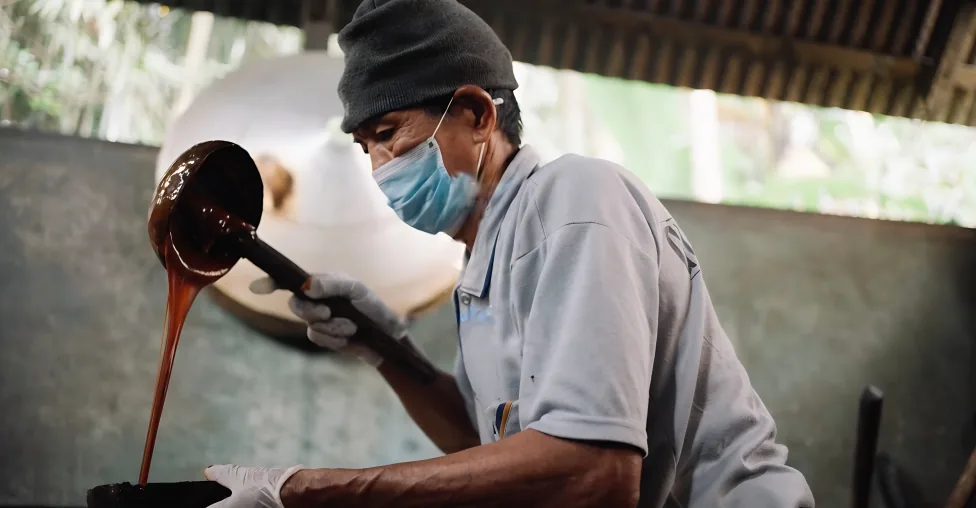
Arenga palm sugar comes from the sap of the sugar palm, Arenga pinnata, tapped by hand in Sumatra and Java, boiled down and dried into granules. Nothing is added. More on how it is made.
How it compares in a brown sugar drink
What changes when you swap the sugar in the pearl syrup.
| Arenga palm sugar | Coconut sugar | Cane brown sugar | White sugar | |
|---|---|---|---|---|
| Flavor | Caramel, toffee, slightly smoky | Mild caramel | Molasses | Neutral sweet |
| Syrup color | Amber to dark brown, darker the longer it cooks | Lighter amber | Dark brown | Clear unless caramelized |
| Streaks on the glass | Yes, from a thick 2:1 syrup | Yes, lighter in color | Yes | Faint |
| With milk and black tea | Rounds off the tea, adds depth | Softer, lighter caramel | Strong, can mask the tea | Sweetness only |
| Total sugar as sucrose | 91.38% | 92.76% | - | Close to 100% |
Sugar content: arenga from Sucofindo Laboratory, Batam (October 2026); coconut sugar from MBRIO Food Laboratory, Bogor (August 2026).
Two syrups for the bar
A common setup is one thick syrup for pearls and glasses, and one thinner syrup to sweeten the tea. These are starting points; adjust to your menu and your sweetness levels.
Pearl syrup, 2:1
Dissolve 2 kg palm sugar in 1 kg (1 litre) water and simmer, stirring, until the syrup coats the back of a spoon. Strain while warm. Drop freshly cooked pearls into it and let them soak, or spoon it up the inside of the glass for streaks.
Pouring syrup, 1:1
1 kg palm sugar in 1 kg hot water, brought just to a simmer, strained and chilled. It mixes into cold tea and milk and is easy to pump and dose.
Cook the pearl syrup a little less if it sets hard when it cools. Each batch of sugar varies slightly, so check the thickness by eye rather than by time alone.
Menu ideas
Which syrup goes where.
| Drink | Syrup | How it is built |
|---|---|---|
| Palm sugar pearl milk | 2:1 pearl syrup | Syrup streaked up the glass, warm pearls from the syrup, ice, then fresh milk. No tea. |
| Palm sugar milk tea with pearls | 2:1 for the pearls, 1:1 in the tea | Strong black tea sweetened with pouring syrup, milk, ice and syrup-soaked pearls |
| Palm sugar oat milk tea | 1:1 pouring syrup | Black or oolong tea with oat milk over ice |
| Palm sugar on toppings | 2:1 pearl syrup | Over grass jelly, pudding or shaved ice |
For syrup and pearl manufacturers
Points to check when palm sugar goes into a production line.
Dissolve warm, then filter
Dissolve in warm water during batching. As an unrefined sugar it can carry a little natural insoluble matter, so include a filter or fine strainer before filling.
Heat darkens the color
Reducing sugars brown during cooking and pasteurization. Expect a bottled syrup or flavored pearl to come out a shade darker than the bench sample and set your color standard after a pilot run.
Dose by weight and Brix
With total sugar above 90%, palm sugar sweetens close to cane sugar by weight. Check Brix on each syrup batch rather than relying on volume.
Labeling
The ingredient is 100% arenga palm sugar, often declared as palm sugar. It is not cane brown sugar, so check the name on your menu and label with your regulatory team.
Which granulation
Mesh is the number of sieve openings per inch; higher means finer.
| Use | Suggested mesh |
|---|---|
| Syrup made in the shop or in a factory | Standard mesh 16 to 20; it all dissolves |
| Dry milk tea premixes and powders | Finer milling up to mesh 22, on request |
Laboratory results
Typical analysis of our arenga palm sugar.
| Parameter | Result |
|---|---|
| Moisture | 1.50% |
| Ash | 1.21% |
| Reducing sugar | 3.11% |
| Total sugar as sucrose | 91.38% |
| Lead, cadmium, mercury, arsenic | Below detection limit |
| Aerobic plate count | 1.0 × 10² CFU/g |
| Yeast and mold | 4.0 × 10¹ CFU/g |
Sucofindo Laboratory, Batam, Report of Analysis No. 141/36.30/1515/09/2026/1. Each lot ships with its own Certificate of Analysis. Full results are in the spec sheet.
Packing by customer type
From syrup factories to a single bubble tea chain.
Syrup, pearl and premix manufacturers
25 kg multi-wall paper sacks with a food-grade PE liner, or 10 to 20 kg PE bags in master cartons. 14 to 15 MT per 20 ft container on pallets.
Bubble tea chains
1 kg kraft pouches for the shop kitchen.
Private label
Your own design on pouches or stick packs (OEM), for retail shelves or for your shops.
From sample to first shipment
Minimum order 5 MT. FOB Tanjung Priok, CIF on request.
- Free sample
Tell us your drink or product and the packing you need. The sample is free and ships by express with its spec sheet and COA. You pay only the courier cost.
- Cook it in your kitchen
Make the pearl syrup, build your best-selling brown sugar drink with it and taste it next to your current syrup.
- Quotation
In USD, valid 14 days. T/T or L/C.
- Production and shipment
Produced and packed in 2 to 3 weeks, shipped with its COA and export documents.
Questions from bubble tea buyers
It plays the same role, a dark and thick syrup for pearls and glass streaks, but it is a different sugar. Arenga palm sugar comes from palm sap, not cane, and tastes of caramel and toffee with a slightly smoky edge. Make both syrups side by side and taste them in your own drink before you switch.
A thick syrup holds a lot of sugar, and when it cools it can crystallize or set. Reduce it a little less, or keep it at the temperature your food safety plan allows for pearls, and make smaller batches more often.
Palm sugar is unrefined, so it can carry a small amount of natural insoluble matter from the sap. Strain the syrup through a fine sieve or cloth while it is still warm.
Yes. 1 kg pouches and 5 g stick packs can carry your design (OEM). Tell us the pack size, quantity and artwork status when you request a quotation.
5 MT per order, which can be split between bulk sacks and retail packs.
Yes. It has a milder caramel note and a lighter syrup color, and comes from a producer with EU and USDA Organic, HACCP and Halal. See coconut sugar.
Cook a batch of pearl syrup with it
We send a free sample with its spec sheet and COA, so your team can test it in your own drinks. You pay only the courier cost.