

- Kopi susu gula arenIced milk coffee sweetened with arenga palm sugar
- 1 to 1Sugar to hot water by weight for a basic syrup
- Mesh 16 to 20Granules that dissolve quickly in hot water
What gula aren is
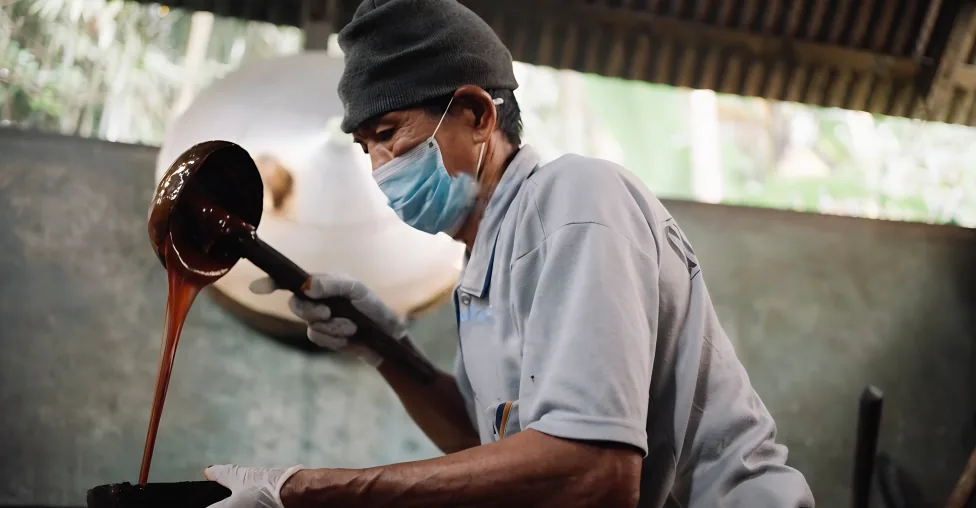
Gula aren is the Indonesian name for sugar from the arenga palm (Arenga pinnata), also called the sugar palm. Farmers tap the sap from the flower stalk and cook it down the same day. Our guide on how arenga palm sugar is made follows each step.
In Indonesian markets you find it as hard blocks (gula cetak) or as free-flowing granules (gula semut). For a café or a factory the granules are easier to work with. They weigh like any dry ingredient, need no chopping and dissolve in minutes.
Why it works in coffee
Arenga palm sugar tastes of caramel with a mild toffee note. In a milk coffee that note sits between the bitterness of a dark roast and the creaminess of the milk, so the drink tastes rounder than one sweetened with white sugar. Coconut sugar is milder and closer to light brown sugar. If you are choosing between them, see arenga palm sugar vs coconut sugar.
- Flavor from one ingredient. The caramel note comes from the sugar itself, so the recipe can stay short.
- Works hot and cold. As a syrup it mixes into iced drinks, where dry sugar would sink to the bottom.
A basic gula aren syrup
- Weigh
Weigh equal amounts of granulated arenga palm sugar and water, for example 1 kg of each.
- Dissolve
Heat the water, add the sugar and stir over low heat until no granules remain. It does not need a hard boil.
- Strain
Pour through a fine sieve or cloth. Unrefined sugar can leave a little fine sediment at the bottom of the pan.
- Cool and store
Cool, bottle and keep chilled. Date each bottle and follow your own food-safety rules for how long you keep it.
Some cafés add a pinch of salt or a pandan leaf while the syrup heats. Try it with your own coffee and milk before you fix the house recipe.
Starting doses
| Drink | Syrup to start with | How to build it |
|---|---|---|
| Iced milk coffee, about 250 ml | 20 to 30 ml | Syrup first, then cold milk and ice, espresso on top |
| Hot latte | 15 to 20 ml | Stir the syrup into the espresso, then add steamed milk |
| Iced milk tea | 20 to 30 ml | Mix the syrup into the tea while it is still warm |
| Bottled or ready-to-drink coffee | Set by your trials | Dose dry sugar by weight on the line instead of syrup |
These are starting points, not a fixed recipe. Adjust them to your coffee, your milk and the sweetness your customers expect.
Buying gula aren for a chain or a factory
A single café can buy small packs. Chains, central kitchens and drink factories usually buy 25 kg sacks and make syrup in one place. These are the points to write into your specification:
- Form
- Granulated arenga palm sugar (gula semut aren)
- Granule size
- Mesh 16 to 20, finer up to mesh 22 on request
- Moisture
- Max 2.0%
- Ingredients
- 100% arenga palm sap
- Shelf life
- 24 months in sealed packaging
- Packing
- 25 kg paper sack with PE liner, 10 or 20 kg PE bag, kraft pouch 250 g to 1 kg, 5 g stick pack
- Documents
- Specification sheet and COA per lot
- Color range. Natural sugar varies a little from lot to lot. Agree the range you accept with a sample.
- Taste as syrup. Check each new lot as syrup in your house drink, not only as dry granules.
- Dissolving. Make sure it dissolves without grit at the temperature you use for syrup.
- Storage. Keep sacks sealed, off the floor and away from damp walls. Open granules take up moisture from the air.
Stick packs and private label
For table service and takeaway, 5 g stick packs let customers sweeten to taste. For retail shelves we pack kraft pouches of 250 g to 1 kg, or packs under your own label. See the arenga palm sugar page for all five packing formats.
Questions buyers ask
No. Both are palm sugars from Indonesia, but gula aren comes from the arenga palm and has a deeper caramel taste. Coconut sugar comes from coconut blossoms and is milder.
You can, but blocks have to be chopped or melted first, and they vary more in size and moisture. Granules weigh and dissolve like any dry sugar, which is why most cafés and factories choose them.
No. We supply granulated arenga palm sugar, and buyers make the syrup on site or in a central kitchen.
A Halal certificate of the producing facility is available on request, and every lot ships with its own Certificate of Analysis. Further certification for our arenga supply is in progress.
To taste it in your own drink, request a free sample. It comes with the specification sheet and a Certificate of Analysis.