

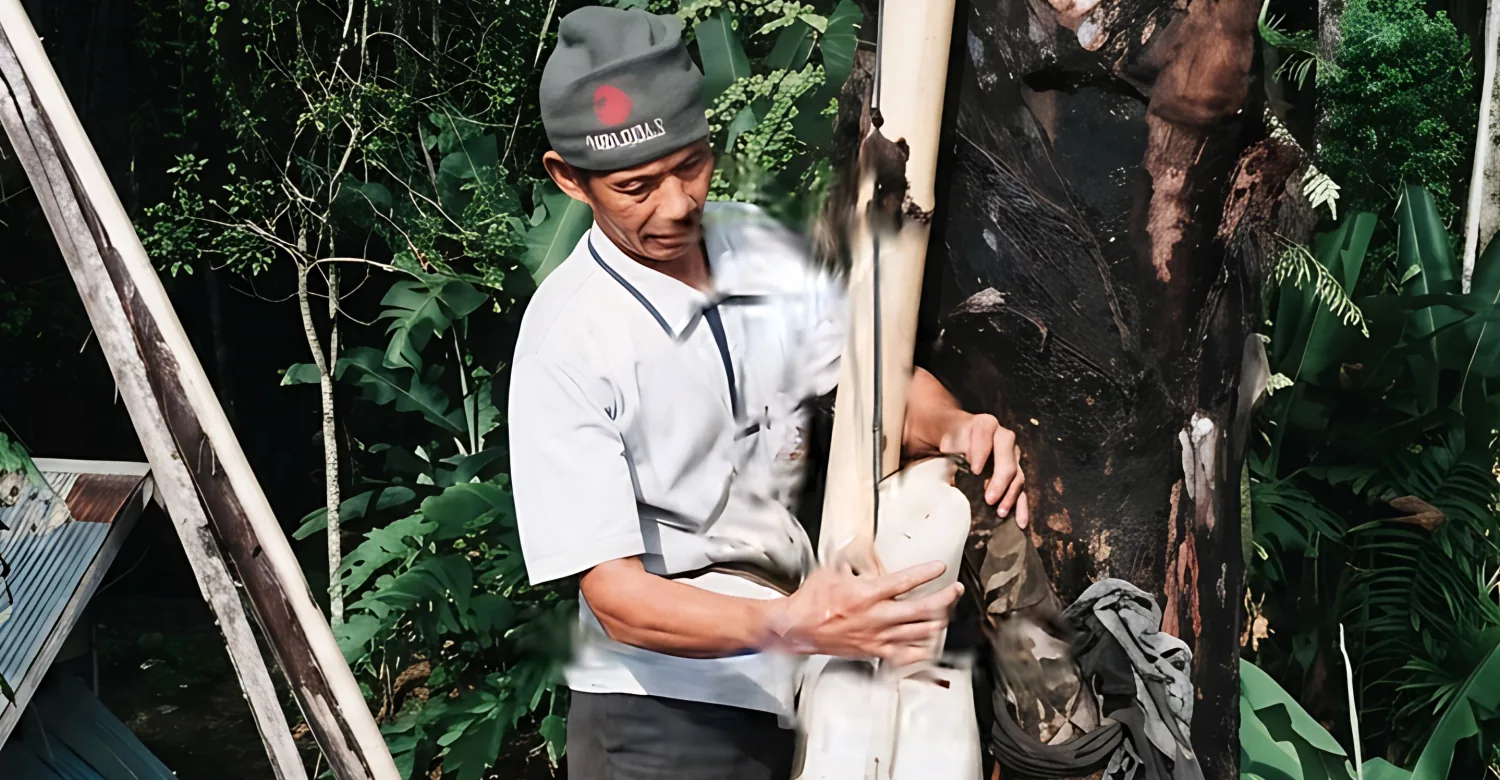
- Arenga pinnataThe sugar palm, called aren in Indonesia
- Same dayFresh sap is cooked within hours of tapping
- Mesh 16 to 20Our standard granule size for export
The sugar palm
The arenga palm (Arenga pinnata) grows wild and in mixed village gardens across Indonesia, often on hillsides alongside coffee, fruit trees and forest. It is a different tree from the coconut palm. Farmers do not cut the palm to harvest it. They tap the sap from its flower stalks, and one palm can be tapped for several years.
Our arenga comes from farmer groups in Sumatra and Java, where palm sugar has been made by hand for generations.
From sap to granules in six steps
- Preparing the flower stalk
The farmer chooses a male flower stalk and gently taps and bends it over a period of days to weeks. This starts the flow of sap.
- Tapping
The stalk is cut and a container hangs under it to collect the dripping sap. Farmers usually collect it in the morning and again in the evening.
- Cooking
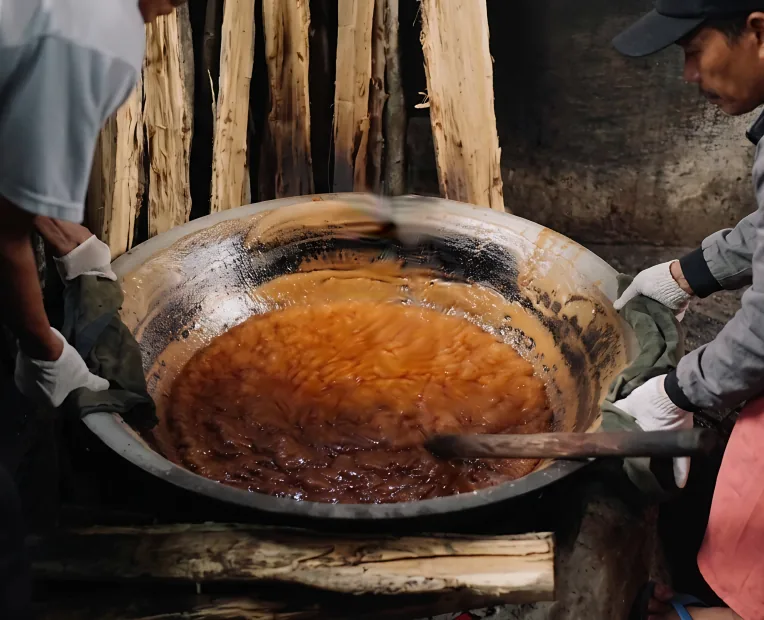
Fresh sap ferments quickly, so it goes straight into a wide pan over a wood fire. It boils for hours while the water evaporates and the colour deepens to caramel.
- Stirring into granules
When the syrup is thick enough, the pan comes off the heat. Constant stirring as it cools makes the sugar crystallise into loose granules instead of a solid block.
- Sieving and drying
The granules are sieved to an even size and dried until moisture is low. Dry sugar flows freely and keeps longer.
- Checking and packing
Each lot is checked for moisture, colour, granule size and foreign matter, then packed in bags with a food-grade liner.
What decides the quality
Two bags of "palm sugar" can behave very differently in a recipe. Most of the difference comes from a few points in the process. These are the questions worth asking any supplier.
| Stage | What can go wrong | What you notice |
|---|---|---|
| Sap collection | Sap waits too long and starts to ferment | Sour notes, darker or uneven colour |
| Cooking | Fire too hot or syrup cooked too long | Burnt, bitter taste |
| Drying | Moisture left in the granules | Clumping and hard lumps in storage |
| Sieving | Granule size not controlled | Uneven dissolving, dust or large crystals |
| Handling | Poor hygiene or open storage | Foreign matter, higher microbial counts |
| Packing | No moisture barrier | Sugar absorbs humidity during shipping |
This is why a specification sheet and a Certificate of Analysis (COA) for the actual lot matter more than a nice photo. If you are new to reading one, our guide to importing palm sugar from Indonesia covers the documents that come with a shipment.
Our standard export spec for arenga palm sugar
- Form
- Granulated (gula semut aren)
- Granule size
- Mesh 16 to 20, finer up to mesh 22 on request
- Moisture
- Max 2.0%
- Shelf life
- 24 months in sealed packaging
- Ingredients
- 100% arenga palm sap
- Packing
- 25 kg paper sacks with PE liner, retail pouches and private label on request
- Documents
- Specification sheet and COA per lot
How it tastes and where it works
Arenga sugar is darker than coconut sugar, with a deep, rich caramel taste. It works well in iced coffee and milk drinks, sauces and marinades, and traditional desserts. If you are choosing between the two, see arenga palm sugar vs coconut sugar.
Questions buyers ask
It is a natural product. Sap varies with season and rainfall, and each cooking batch differs slightly. A COA per lot and a sample before you order help you set the range you accept.
Not yet. Certification for our arenga supply is in progress, and a Halal certificate of the producing facility is available on request. Our coconut sugar comes from a producer certified for EU Organic, USDA Organic, HACCP and Halal.
Yes. Our standard is mesh 16 to 20, and our producing partner can go finer, up to mesh 22, on request. Tell us your application and we will suggest a size.